

Minimally Invasive Bunion Surgery
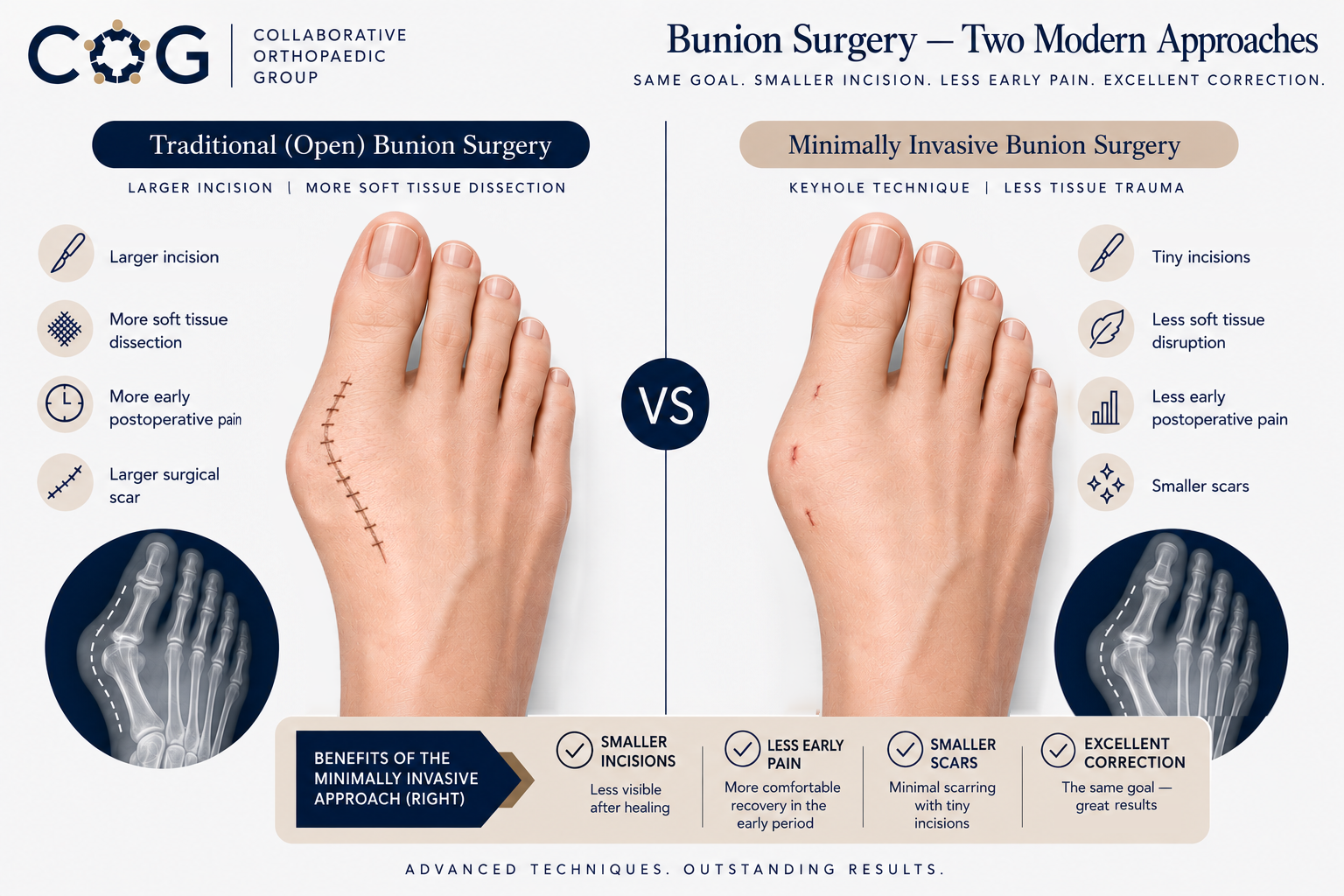
Minimally invasive bunion surgery, sometimes called keyhole or percutaneous bunion surgery, corrects a bunion through incisions of around 5mm rather than the longer incision used in traditional open surgery.
Specialised burrs are used to cut the bone under X-ray guidance, the bone is realigned, and screws are placed to hold the correction while it heals. The principle is the same as open surgery — the deformity is corrected at the level of the bone — but the soft tissues are disturbed far less in reaching it.
How does it differ from open surgery?
Incision size: Several incisions of around 5mm, rather than one longer incision along the side of the foot.
Soft tissue disruption: Less stripping of tissue from the bone, which is thought to contribute to reduced post-operative pain and swelling.
Scarring: Smaller scars that generally fade to faint marks.
Recovery: Many patients walk in a post-operative shoe from day one, as they do after open surgery, but often with less early discomfort.
Correction of the deformity and long-term outcomes are broadly comparable between the two techniques in appropriately selected patients. Keyhole surgery is a different way of reaching and cutting the bone, not a different or lesser correction.
Is it suitable for everyone?
No, and this matters. Minimally invasive surgery suits many bunions but not all. It is generally less suitable where:
The deformity is very severe
There is significant arthritis in the big toe joint, which may need a different operation altogether
There is marked instability at the base of the first ray
Previous surgery has altered the anatomy
In those situations an open procedure may give a more reliable correction. The technique is chosen to fit the foot rather than the other way round.
What does recovery involve?
Day one: Most patients walk in a flat post-operative shoe. Day surgery in most cases.
First two weeks: Elevation is the single most useful thing you can do. Walking is limited to what is necessary.
Two to six weeks: Continuing in the post-operative shoe, with gradual increase in walking as comfort allows.
Six to twelve weeks: Transitioning into supportive normal footwear. X-rays confirm the bone has healed.
Three to six months: Return to most activities and footwear. Swelling commonly persists for several months and is expected.
Risks
The risks are broadly those of bunion surgery generally: infection, nerve irritation or numbness around the incisions, delayed bone healing, stiffness of the big toe, recurrence of the deformity over time, and irritation from the screws occasionally requiring their removal. No technique eliminates the possibility of recurrence.
Dr Janan's approach
Dr Janan trained in minimally invasive forefoot surgery during his fellowship in Bristol, a major United Kingdom foot and ankle centre, and in Tokyo under Professor Satoru Ozeki, past president of the Japanese Society for Surgery of the Foot.
He performs mainly minimally invasive bunion surgery but sometimes open bunion correction is the preferred option. Which is recommended depends on the shape and severity of your deformity, previous surgery in the area, the state of the joint and your imaging — not purely on a preference for one technique.
Wondering whether keyhole bunion surgery suits your foot?
Book a consultation with Dr Janan Chandrananth to have your bunion assessed and find out which technique is appropriate.
FAQs
Is keyhole surgery always better than open surgery?
No. It offers smaller incisions and often less early discomfort, but the correction achieved and the long-term result are broadly comparable when patients are appropriately selected. For some bunions an open procedure remains the more reliable option, and choosing the technique to fit the foot matters more than the technique itself.
Can I walk straight away?
Most patients walk in a flat post-operative shoe from day one. That does not mean walking freely — elevation and rest in the first two weeks make a substantial difference to swelling and to the eventual result.
How long until I can wear normal shoes?
Usually around six to twelve weeks into supportive footwear, though this varies. Narrow or fashion shoes generally take longer, often several months, because swelling persists.
Will the bunion come back?
Recurrence is possible with any bunion operation. It is influenced by the severity of the original deformity, the underlying foot shape and how well the correction is held while healing. No technique removes the possibility entirely.
Will I need the screws removed?
Usually not. The screws are generally left in place permanently and cause no problems. A small number of patients find them irritating and choose to have them removed once the bone has healed.
Can both feet be done at once?
Sometimes, but it is worth thinking carefully about. Having both done together means one recovery period rather than two, but it also means managing without an unaffected foot to rely on. This is discussed individually.
Related reading: Is Minimally Invasive (Keyhole) Foot Surgery as Effective as Open Surgery?
Choosing a surgeon: Who is the best bunion surgeon in Melbourne? explains what to look for and what to ask before you book.