

Meniscal Tear
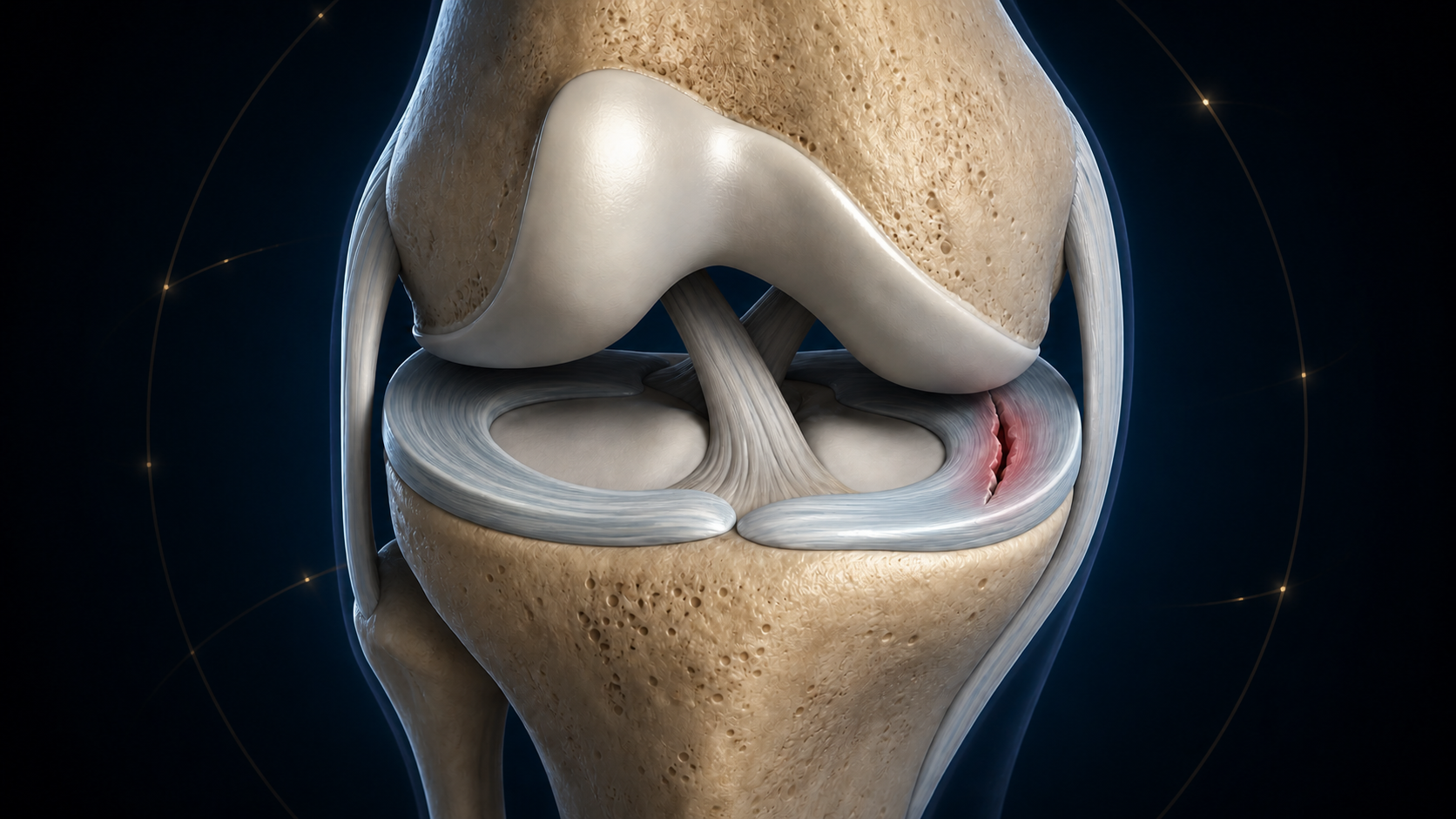
A meniscal tear is one of the most common knee injuries. The menisci are two wedge-shaped pieces of cartilage that sit between the thigh bone and shin bone, acting as shock absorbers and helping to spread load evenly across the knee. A tear can cause pain, swelling and a sensation of the knee catching or locking.
Causes
Meniscal tears fall broadly into two groups:
Traumatic tears: These usually occur during sport or activity involving twisting or pivoting on a bent knee. They are more common in younger, active people and often happen alongside ligament injuries.
Degenerative tears: As the meniscus weakens with age, it can tear with relatively little force — sometimes simply squatting or rising from a chair. These tears are common from middle age onwards and often occur alongside early arthritis.
Symptoms
Common symptoms of a meniscal tear include:
Pain: Typically felt along the inner or outer joint line, often worse with twisting or deep bending.
Swelling: Usually develops over the first day or two rather than immediately.
Catching or locking: A torn fragment can interfere with joint movement, causing the knee to catch or become stuck.
Restricted movement: Difficulty fully straightening or bending the knee.
Giving way: A sense that the knee is unreliable, particularly on uneven ground.
Diagnosis
Diagnosis typically involves:
History and examination: The mechanism of injury and specific examination tests give a good indication of whether the meniscus is involved.
Imaging: An X-ray is used to assess the joint and look for arthritis. MRI shows the meniscus and surrounding soft tissues in detail and confirms the pattern of the tear.
Treatment
Not every meniscal tear requires surgery. Treatment depends on the type and location of the tear, your symptoms, your age and activity level, and the condition of the rest of the knee.
Non-surgical treatments include:
Activity modification
Physiotherapy and strengthening programs
Pain relief medication
Anti-inflammatory medication
Injections in selected cases
Surgical options include:
Arthroscopic meniscal repair — stitching the tear so it can heal
Arthroscopic partial meniscectomy — trimming the torn portion
Where a tear is repairable, preserving meniscal tissue can help protect the knee over the longer term. Repair is more often possible in younger patients and in tears located in the better-supplied outer portion of the meniscus.
Dr Janan will assess your knee, review your imaging and discuss whether your tear is one that is likely to benefit from surgery or from a non-surgical approach.
Not sure if your knee needs surgery?
FAQs
Can a meniscal tear heal on its own?
The outer third of the meniscus has a blood supply and some tears in this area can heal, particularly in younger patients. The inner portion has very little blood supply and tears there generally do not heal on their own. That said, many people become comfortable without the tear healing, as symptoms settle and the knee adapts.
Do I need an MRI?
Not always. History and examination often give a clear picture, and an X-ray is usually the first investigation. An MRI is helpful when the diagnosis is uncertain, when surgery is being considered, or when other structures such as ligaments may also be injured.
How long is the recovery after meniscal surgery?
Recovery differs considerably between the two operations. After a partial meniscectomy many people are walking comfortably within a couple of weeks and returning to sport within six to eight weeks. A meniscal repair needs to be protected while it heals, often with restricted weight-bearing and bending for around six weeks, with return to sport usually taking four to six months.
Will a meniscal tear lead to arthritis?
Losing meniscal tissue increases load on the joint surface and can contribute to arthritis over time, which is part of why repair is preferred where it is possible. Many degenerative tears also occur as an early sign of arthritis that is already developing.
If surgery is recommended. Most meniscal surgery is done arthroscopically — knee arthroscopy explains what happens during the procedure and what recovery looks like.