

ACL Injury
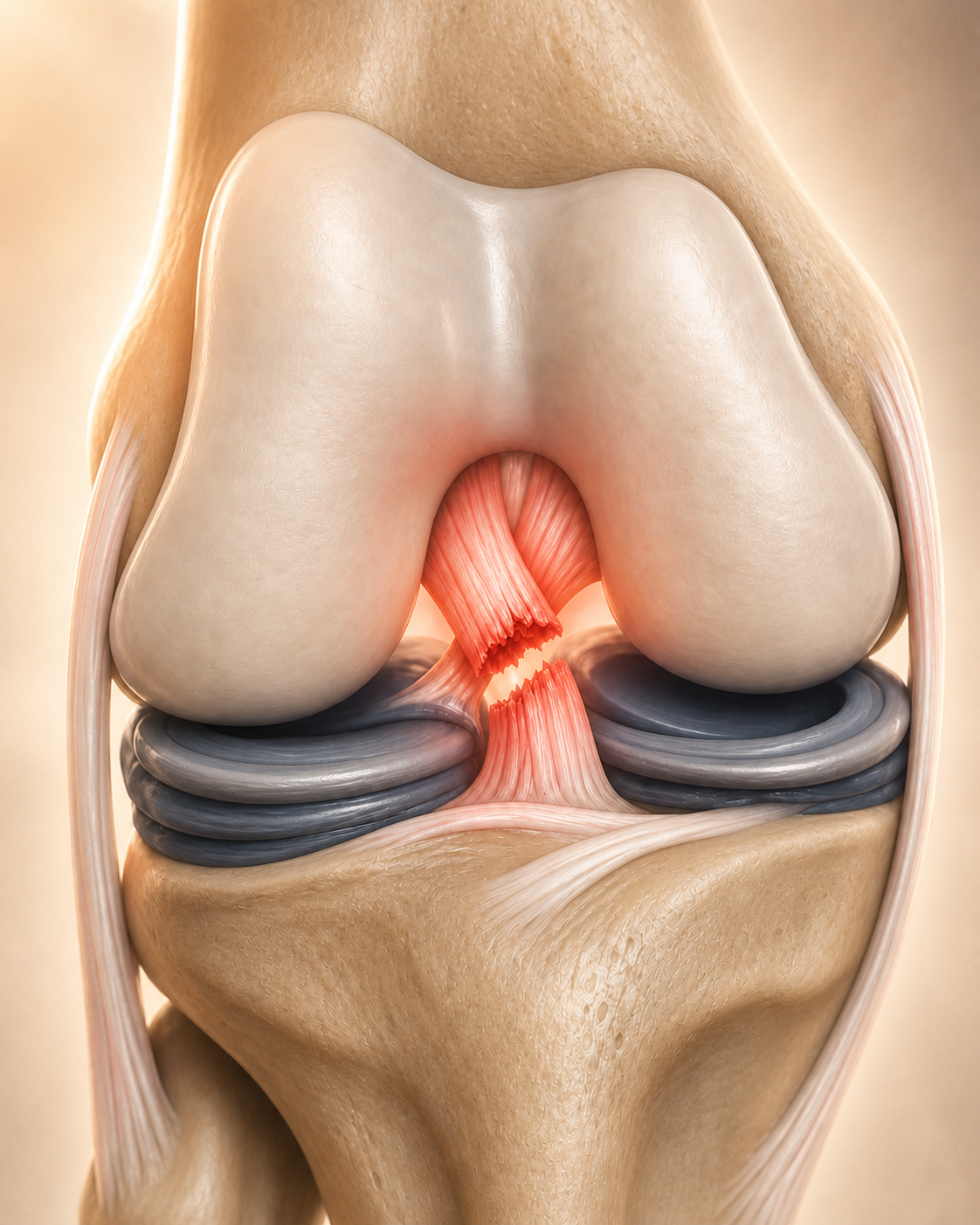
The anterior cruciate ligament (ACL) is one of the main stabilising ligaments inside the knee. It prevents the shin bone sliding forward on the thigh bone and controls rotation. An ACL injury is a common sporting injury and can leave the knee feeling unstable, particularly during twisting, pivoting or changing direction.
Causes
Most ACL injuries happen without contact. Typical mechanisms include:
Pivoting or twisting: Changing direction suddenly with the foot planted, common in football, netball, basketball and skiing.
Awkward landing: Landing from a jump with the knee relatively straight or collapsing inwards.
Sudden deceleration: Stopping abruptly while running.
Direct contact: A blow to the outside of the knee, which may also injure other ligaments.
Symptoms
Common symptoms of an ACL injury include:
A pop or snap: Many people hear or feel a distinct pop at the moment of injury.
Immediate swelling: Significant swelling usually develops within a few hours, caused by bleeding within the joint.
Pain: Often severe at the time, settling over the following days.
Giving way: A sense of the knee buckling, particularly when turning or on uneven ground.
Restricted movement: Difficulty fully straightening or bending the knee while it remains swollen.
Diagnosis
Diagnosis typically involves:
History and examination: The mechanism of injury together with specific stability tests usually makes the diagnosis clear.
Imaging: An X-ray excludes fracture. MRI confirms the ACL injury and identifies associated injuries to the menisci, cartilage or other ligaments, which are common.
Treatment
Not everyone with an ACL injury needs reconstruction. The decision depends on your symptoms, your age, the sports and work you want to return to, and whether other structures in the knee are also injured.
Non-surgical treatments include:
Structured physiotherapy and rehabilitation
Neuromuscular and balance retraining
Activity modification
Bracing for selected activities
Surgical options include:
ACL reconstruction usually with a hamstrings tendon graft (patellar tendon or quadriceps tendon graft are also options)
Repair or treatment of associated meniscal and cartilage injuries at the same time
Reconstruction is generally recommended for people who wish to return to pivoting sports, whose work demands a stable knee, or whose knee continues to give way despite good rehabilitation. People with lower physical demands can often manage well with rehabilitation alone.
Whichever path is chosen, rehabilitation does the majority of the work. Dr Janan will assess your knee, review your imaging and discuss which approach best fits the activities you want to get back to.
Wondering whether you need a reconstruction?
FAQs
Do I definitely need surgery after an ACL tear?
No. The ACL does not heal well on its own, but not everyone needs it reconstructed. The decision is based on how unstable the knee feels, what you want to return to, and whether other structures are injured. Someone returning to netball or football is far more likely to need reconstruction than someone whose activities are mostly straight-line.
How soon after the injury is surgery done?
Surgery is rarely done immediately. It is generally better to wait until swelling has settled and the knee has regained close to full movement, which usually takes several weeks of physiotherapy. Operating on a stiff, swollen knee increases the risk of stiffness afterwards.
How long until I can return to sport?
Return to pivoting sport after ACL reconstruction typically takes nine to twelve months. Returning too early carries a meaningful risk of re-injury, and decisions about return are based on strength, movement control and confidence rather than time alone.
Which graft is used?
Hamstring, patellar tendon and quadriceps tendon grafts are all used and all have reasonable outcomes. The choice depends on your sport, your anatomy, whether this is a first or revision surgery, and a discussion about the trade-offs of each.
Can I injure the same knee again?
Yes, re-injury is possible, as is injury to the other knee. Completing a full rehabilitation program and meeting return-to-sport criteria before going back to pivoting activity meaningfully reduces that risk.