

Is Minimally Invasive (Keyhole) Foot Surgery as Effective as Open Surgery?
If you’ve been told you need foot or ankle surgery, you may have come across the term “minimally invasive” or “keyhole” surgery, and wondered whether it’s genuinely as effective as traditional open surgery. It’s a fair question, and the honest answer is: it depends on the condition, and on your individual case.
What Is Minimally Invasive Foot Surgery?
Minimally invasive foot and ankle surgery uses small incisions, typically just a few millimetres, along with specialised instruments and, in many cases, X-ray guidance to correct the underlying problem without the larger incisions used in traditional open surgery. It’s sometimes called percutaneous or keyhole surgery, since surgeons often work through tiny openings rather than a single larger cut.
This differs from open surgery, where a larger incision gives the surgeon direct visual access to the bone and soft tissue.
How Does It Compare to Open Surgery?
For a growing number of conditions, particularly bunions, lesser toe deformities, and some forefoot procedures, well-conducted studies have shown minimally invasive techniques can achieve comparable correction and pain relief to open surgery, while often offering:
Smaller scars, which tend to be less noticeable over time
Less soft tissue disruption, which can mean less post-operative swelling
Potentially reduced infection risk, given the smaller wound size
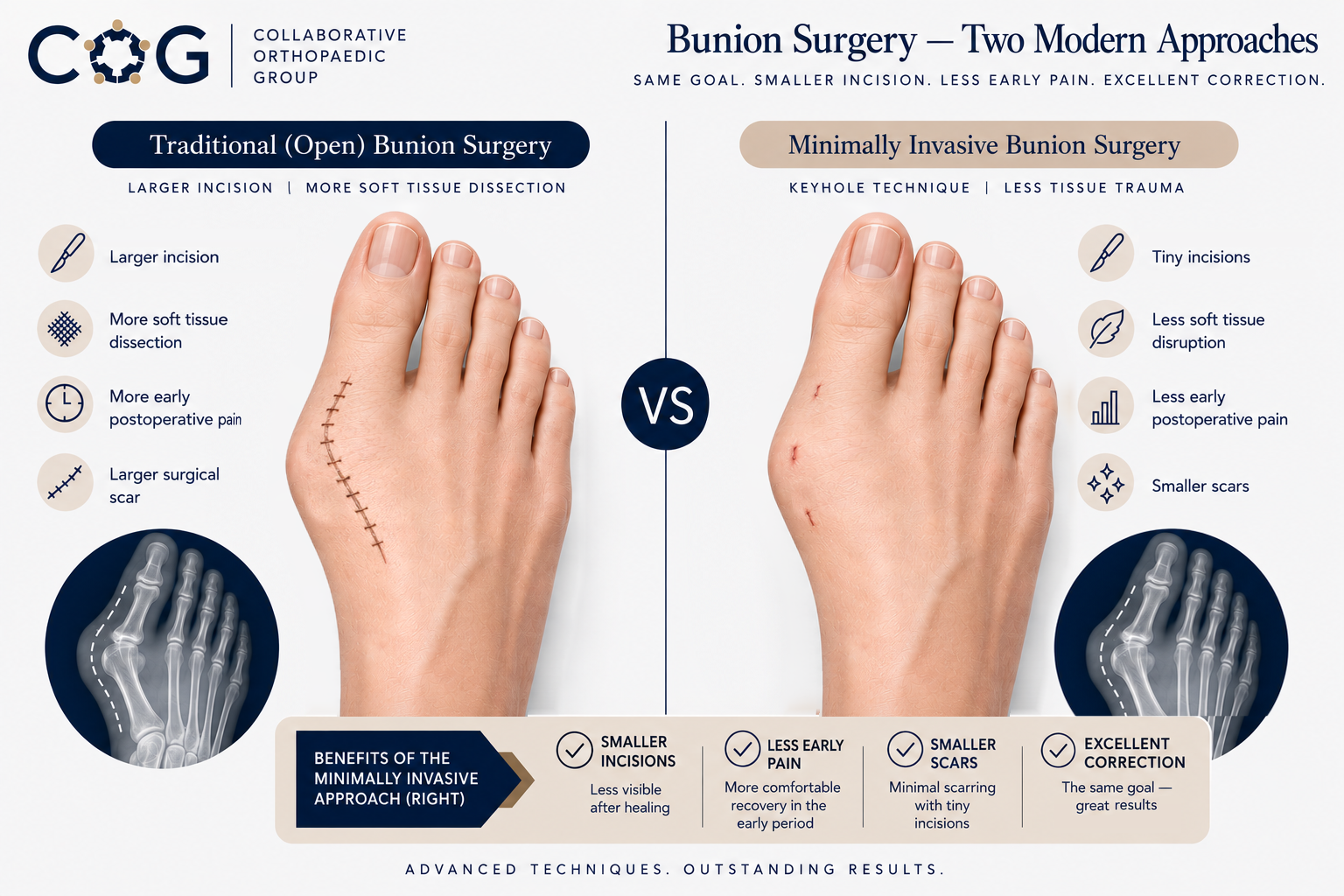
That said, minimally invasive doesn’t automatically mean better in every case. The technique needs to be matched to the right condition and the right patient. Some more complex deformities, revision surgeries, or cases involving significant bone loss may still be better served by an open approach, where the surgeon has more direct visual control over the correction.
Is It Right for Everyone?
Not necessarily. The suitability of minimally invasive surgery depends on factors including:
The specific condition and its severity
Your individual foot and ankle anatomy
Whether it’s a first-time procedure or a revision
Your surgeon’s training and experience with the technique
This is why a thorough individual assessment matters more than the surgical label itself. A well-performed open procedure will often outperform a poorly-suited minimally invasive one, and vice versa.
Recovery: What’s Actually Different?
Where minimally invasive techniques often do show a genuine advantage is in the early recovery period. Smaller incisions generally mean:
Less immediate post-operative pain
Reduced swelling in the first few weeks
A quicker return to a supportive shoe, in appropriate cases
Longer-term outcomes, such as correction of the deformity and reduced recurrence, depend more on surgical technique and case selection than on incision size alone.
Dr Janan’s Approach
Dr Janan Chandrananth trained in specialised arthroscopic and minimally invasive techniques during his fellowship in Bristol (UK), working alongside surgeons with extensive experience across the full range of foot and ankle conditions. He uses minimally invasive techniques where they’re genuinely the best option for a patient’s condition and anatomy, rather than applying a one-size-fits-all approach.
During your consultation, Dr Janan will assess your specific case, including imaging, foot structure and the severity of your condition, to recommend whether a minimally invasive or open approach is more appropriate for you.
Key Takeaways
Minimally invasive foot surgery can be as effective as open surgery for many common conditions, particularly bunions and lesser toe deformities
It’s not automatically the best choice for every patient or every condition
The right technique depends on your individual case, not just which one sounds less invasive
Recovery in the early weeks is often more comfortable with minimally invasive approaches, though long-term results depend on proper technique and case selection
Ready to discuss your treatment options?
Book a consultation with Dr Janan Chandrananth to discuss your foot or ankle condition and the treatment options available.
Related reading: Bunions