

Knee Arthroscopy
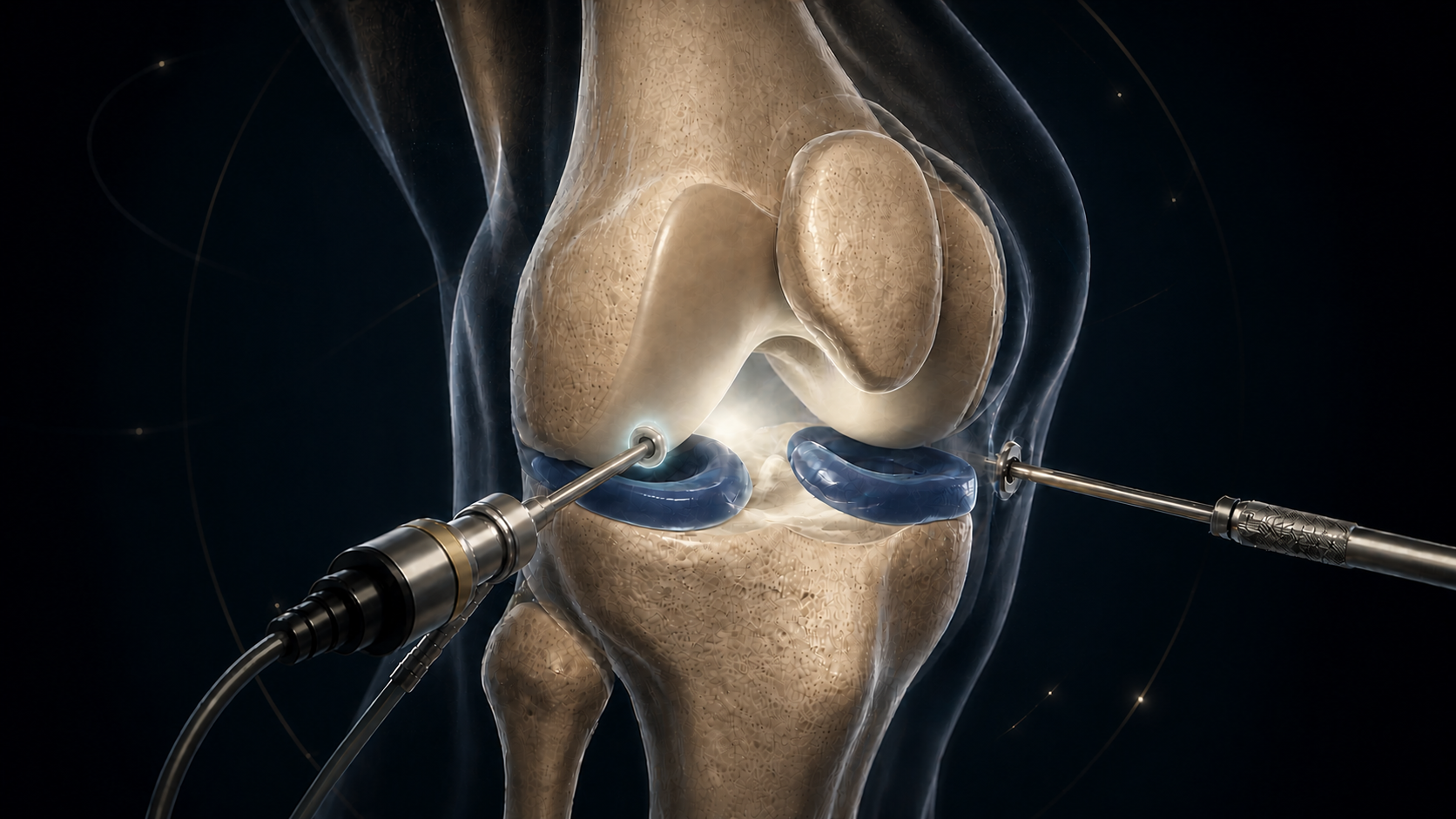
Knee arthroscopy is a keyhole operation that allows the inside of the knee to be examined and treated through small incisions. A camera is inserted into the joint and the images are viewed on a screen, with fine instruments used through a second small incision to carry out the necessary treatment.
When is an arthroscopy used?
An arthroscopy may be recommended for:
Meniscal tears: Repairing or trimming a torn meniscus.
Loose bodies: Removing fragments of cartilage or bone that are catching in the joint.
Cartilage damage: Assessing and treating damaged joint surfaces.
Ligament reconstruction: ACL reconstruction is performed arthroscopically.
Persistent locking or catching: Where a mechanical problem within the joint is suspected.
When is it not the right operation?
Arthroscopy is not the definitive treatment for arthritis on its own. Where knee pain is caused primarily by arthritis rather than a mechanical problem, like a torn meniscus, arthroscopy is unlikely to help the arthritis pain, and other treatments are more appropriate. This is an important distinction, and part of why careful assessment and imaging matter before proceeding.
What does the operation involve?
The procedure is usually performed as day surgery under general anaesthetic and typically takes under an hour, depending on what needs to be done. Two or three small incisions are made around the knee. Most people go home the same day, walking with crutches initially.
Recovery
Recovery depends on what was done inside the knee:
Simple procedures: After removal of a loose body or trimming of a meniscal tear, many people are walking comfortably within one to two weeks and back to most activities by four to six weeks.
Meniscal repair: Requires protection while the repair heals, often with restricted weight-bearing and bending for around six weeks, and a longer return to sport.
All procedures: Some swelling is normal for several weeks. Physiotherapy is used to restore movement, strength and confidence.
Risks
Arthroscopy is generally a low-risk operation, but no surgery is without risk. Possible complications include infection, blood clots, stiffness, ongoing pain, and injury to structures within or around the knee. These are uncommon and will be discussed with you before surgery.
Dr Janan will assess your knee and review your imaging to determine whether an arthroscopy is likely to help in your situation, and will be clear with you if it is not.
Not sure if arthroscopy is right for your knee?
FAQs
Will an arthroscopy fix my knee arthritis?
No. Current evidence shows that arthroscopy does not provide lasting benefit for knee pain caused by arthritis, and it is not recommended for that purpose. Where arthritis is the main problem, non-surgical management, osteotomy or joint replacement are the appropriate options depending on severity.
How soon can I walk after the operation?
Most people walk on the day of surgery, usually with crutches for the first few days. If a meniscal repair has been performed, weight-bearing may be restricted for several weeks to protect the repair.
When can I drive again?
Generally once you can control the vehicle safely, are off strong pain relief, and can perform an emergency stop without hesitation. For a simple arthroscopy on the right knee this is often around one to two weeks, but it varies.
Will I have a scar?
The incisions are small, usually under a centimetre, and typically fade to faint marks over time.
How soon can I return to sport?
After a straightforward arthroscopy, many people return to running and sport around six weeks, guided by comfort, swelling and strength. After a meniscal repair or ligament reconstruction the timeline is considerably longer.