

Ankle Fusion vs Ankle Replacement: Which Is Right for Me?
If you’re living with advanced ankle arthritis and non-surgical treatments are no longer controlling your pain, you may have been told there are two main surgical options: ankle fusion or total ankle replacement. Neither is universally better; the right choice depends on your age, activity level, anatomy and goals. Here’s how the two compare.
Why Would I Need One of These Procedures?
Both procedures are typically considered for end-stage ankle arthritis, where the cartilage lining the joint has worn away and bone rubs on bone. In the ankle, this is often the result of previous injury, such as fractures or repeated sprains, though it can also develop from osteoarthritis or inflammatory conditions like rheumatoid arthritis. Surgery is usually discussed once bracing, activity modification, medication and injections are no longer providing enough relief.
What Is Ankle Fusion?
Ankle fusion, also called arthrodesis, permanently joins the bones of the ankle joint so they heal into one solid piece of bone. By eliminating movement at the worn-out joint, it removes the source of the arthritic pain. Fusion has a long track record and is known for being durable and reliable, which is why it has traditionally been the standard operation for severe ankle arthritis.
The trade-off is that the ankle no longer bends up and down at the fused joint. Neighbouring joints in the foot compensate to a degree, and most people walk well after fusion, but over many years the extra load on those adjacent joints can contribute to wear.
What Is Ankle Replacement?
Total ankle replacement removes the damaged joint surfaces and replaces them with implants, similar in principle to hip or knee replacement. Because the joint itself is preserved rather than fused, replacement maintains ankle movement, which supports a more natural walking pattern and reduces the extra stress placed on neighbouring joints.
The trade-off is that implants can wear or loosen over time, and some patients may eventually need revision surgery. Replacement also isn’t suitable for everyone; factors such as bone quality, significant deformity, or very high physical demands can make fusion the more appropriate option.
How Do They Compare?
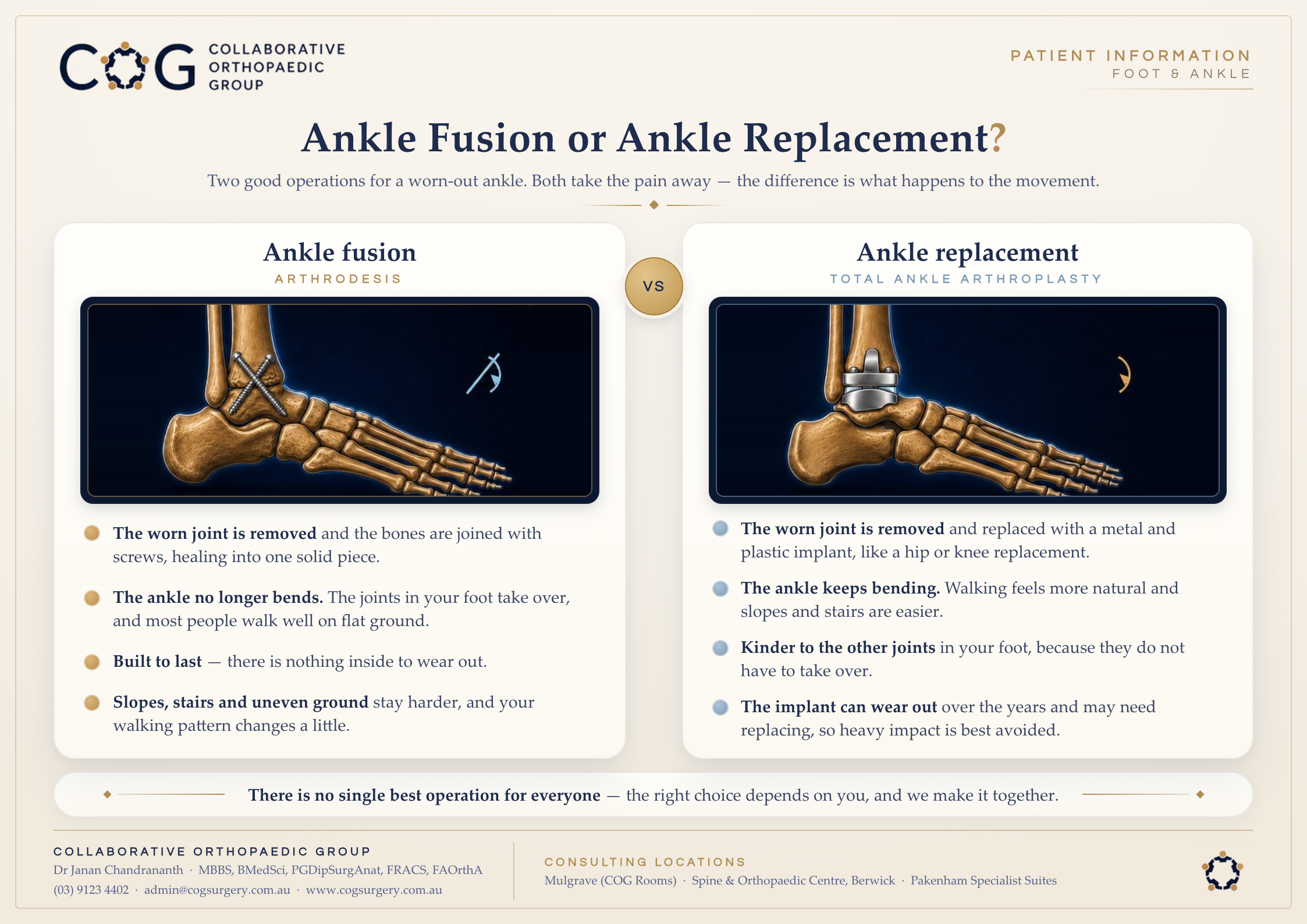
Both procedures reliably relieve arthritic pain, but they differ in a few important ways:
Movement: replacement preserves ankle motion; fusion sacrifices it for stability
Durability: a successful fusion is permanent; replacement implants can wear and may need revision over time
Adjacent joints: fusion shifts extra load onto nearby joints over the years; replacement helps protect them
Suitability: replacement generally suits lower-demand patients with good bone quality and alignment; fusion is often preferred for younger, high-demand patients or complex deformity
Which One Is Right for Me?
There’s no single right answer. The decision comes down to your individual circumstances, including your age, how active you are or want to be, your occupation, the quality of your bone and alignment, the condition of the surrounding joints, and your own priorities around movement versus long-term durability. A thorough assessment, including imaging, is essential before recommending one over the other.
Dr Janan’s Approach
Dr Janan Chandrananth received further specialised foot and ankle surgery training during fellowships in Bristol (UK) and Tokyo, including under Professor Satoru Ozeki, a past president of the Japanese Society for Surgery of the Foot. He performs both ankle fusion and ankle replacement, which means his recommendation is based on what suits your circumstances rather than a preference for one technique.
During your consultation, Dr Janan will review your imaging, examine your ankle and surrounding joints, and talk through what each option would mean for your lifestyle, so you can make an informed decision together.
Key Takeaways
Both fusion and replacement reliably relieve the pain of end-stage ankle arthritis
Fusion trades ankle movement for proven durability; replacement preserves movement but implants may need revision
Replacement tends to suit lower-demand patients with good bone and alignment; fusion often suits younger or higher-demand patients
The right choice is individual, and a thorough assessment with imaging is essential before deciding
Ready to discuss your treatment options?
Book a consultation with Dr Janan Chandrananth to discuss your foot or ankle condition and the treatment options available.
Related reading: Ankle Arthritis